Blocks are some of the best props to improve flexibility and stay safe in your yoga practice. Tight muscles can hold us in shapes that compromise the spine. When you use blocks to stay in alignment, you will be able to access more of your body’s range of motion.
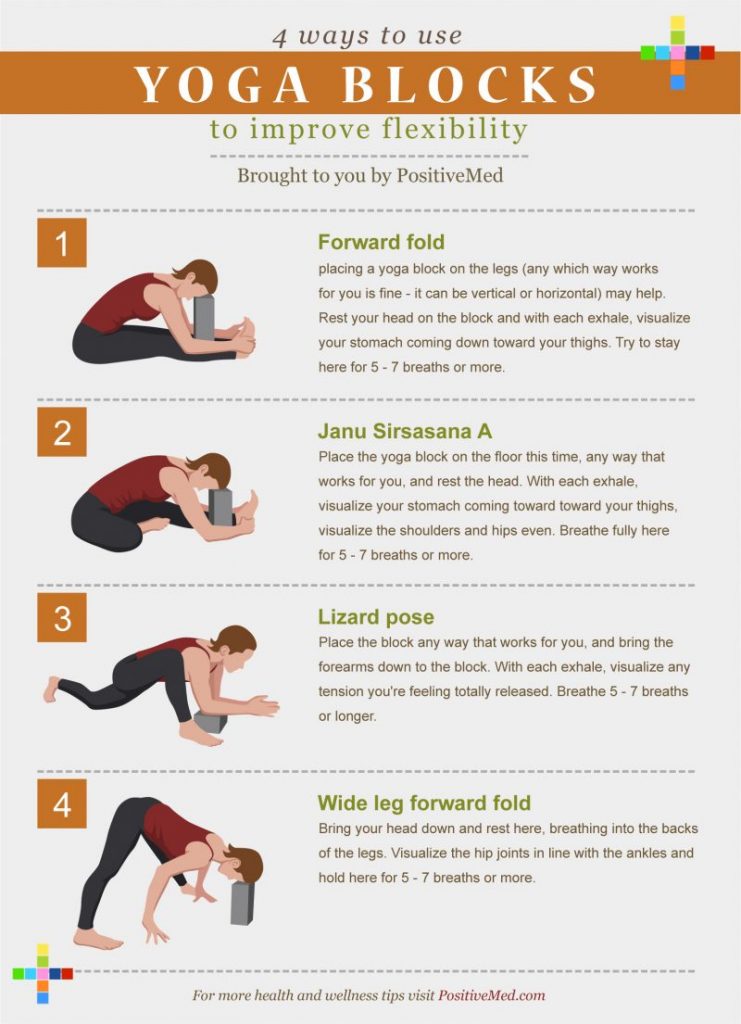
You will notice that in three of the four images, the forehead comes to rest on the block. This action stimulates the parasympathetic nervous system’s relaxation response, which offers us to improve flexibility.
Prop Principles
You can change the block’s height at any point for any of these postures. You may opt to use multiple blocks if you need additional support. Be sure that your blocks feel stable, especially if you will be putting a lot of weight on them.
Forward Fold
Sit with your legs outstretched in front of you. Straighten your posture, and inhale to create an axial extension. Place your block between your knees at the height appropriate for your flexibility level. If you are not feeling flexible, use the highest setting or even multiple blocks to support yourself. On an exhale, fold forward to place your forehead on the block. A slight bend in the knees protects the lower back. Hold this asana for one to three minutes.
RELATED ARTICLE: Release Your Stress And Calm Your Hormones With THESE Easy Yoga Poses
Janu Sirsasana A
Sit on the floor with both legs extended in front of you. Draw one heel toward your groin. Place a block on the inside of your outstretched leg. Inhale to create a straight spine. Exhale and square your shoulders over your outstretched leg. Inhale your arms overhead, and ground down through your sitting bones. Maintain length and integrity in your spine. Fold on an exhale. When you have folded as far as you are able, place your forehead on the block. For increased flexibility, maintain this posture for at least one minute per side. Repeat for the other side.
Lizard Pose
Begin in Downward-facing Dog with a block resting between your hands on the lowest setting. Extend one leg into the air for Three-legged Dog, and then slowly bring your raised foot to rest along the outside of the hand on the corresponding side. You may choose to tap the back knee down or leave the leg extended. Rest your forearms on the block(s) on the lowest setting. One to three minutes on each side will provide a nice stretch for your hips. This is excellent preparation for postures such as Wild Thing and Side Lunge.
Wide-Legged Forward Fold
Step into a wide-legged stance. Press the knife edges of your feet into the mat. Place one a block in front of you. Inhale to grow tall, and on an exhale, hinge your hips to fold forward. Place the block under the crown of your head. You will be able to lower the block height as your flexibility increases. This is great preparation for Tripod Headstand. Remain in this posture for up to a minute.
Blocks are not crutches: they are valuable tools for increasing your flexibility.