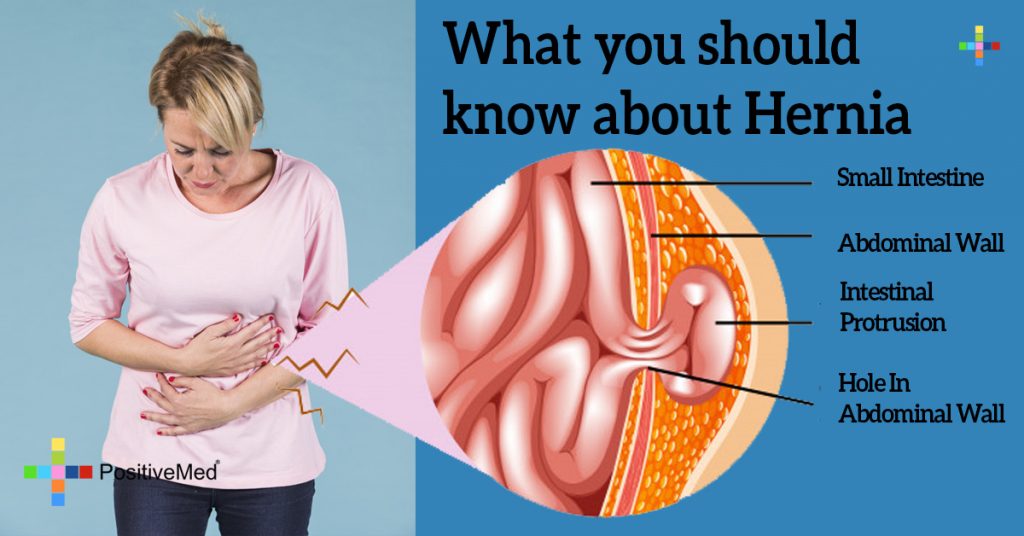
What you should know about Abdominal Hernia
By Khrystyana Kirton
Edited By Stephanie Dawson
Reviewed By Nima Shei MD
A hernia is a protrusion of tissue from one area of the body through the wall that contains it. The abdomen is a common place for hernias to occur. Hernias may be present at birth due to incomplete closure of a structure, or they may develop later due to increased abdominal pressure pushing against a weakened area of muscle or its fibrous sheath (fascia). Inguinal hernias, which occur in about five in 100 children, more frequently in boys than girls, are the most common type of abdominal hernias.
Inguinal hernias and femoral hernias are both groin hernias, and they occur in the area between the lower abdomen and the thigh. Umbilical hernias occur directly beneath or near the navel. Hernias that occur where a surgery has taken place are called incisional hernias. Two other types of abdominal hernias, known as ventral and epigastric hernias, often occur in the middle of the abdomen, although ventral hernias can also occur in other locations in the abdomen.
Abdominal hernias typically include some of the membranous sac that encircles the abdominal organs (the peritoneum). They may also include fatty tissue and portions of the intestine. They may or may not be painful, and they are typically seen as a bulge in the abdomen, groin, labia or scrotum that increases in size over time. Most abdominal hernias are reducible as their contents can be pushed back into the abdomen, at least temporarily.
Common symptoms of an abdominal hernia include, but aren’t limited to:
- A bulge under the skin in the abdomen
- Pain when lifting or coughing
- Pain after a long period of standing or sitting
- Pain from straining during a bowel movement
Abdominal hernia pain can vary from a dull, constant pain to a sharp pain that worsens when the abdomen is under pressure. If the pain is severe and/or if there is redness in the area of the hernia, a physician should be consulted right away.
Surgery is typically required in the treatment of hernias to remove the portion of the peritoneum that is protruding through the opening, and to close and reinforce the opening. Occasionally, blood supply to the tissues protruding through the opening can be diminished, resulting in tissue “strangulation.” This is a medical emergency that requires immediate treatment to prevent tissue death. Tissue strangulation is typically accompanied by intense pain.
Intestinal strangulation is a potentially life-threatening medical emergency that requires immediate treatment to reduce the risk of bowel loss. Seek immediate medical care if you, or someone you are with, have symptoms such as severe abdominal pain; increased swelling of a known hernia; a painful new bulge or mass; severe nausea and vomiting; inability to have bowel movements or pass gas; decreased or absent urine output; or high fever (higher than 101 degrees Fahrenheit).
Seek prompt medical care for bulges in the abdomen or groin, especially if they increase in size or become painful, or if you have been treated for an abdominal hernia but symptoms recur.
SOURCES
Abdominal Hernia, Hernia Symptoms (dot) org –